


 |
市场调查报告书
商品编码
1911390
马来西亚设施管理市场:市场占有率分析、产业趋势与统计、成长预测(2026-2031)Malaysia Facility Management - Market Share Analysis, Industry Trends & Statistics, Growth Forecasts (2026 - 2031) |
||||||

※ 本网页内容可能与最新版本有所差异。详细情况请与我们联繫。
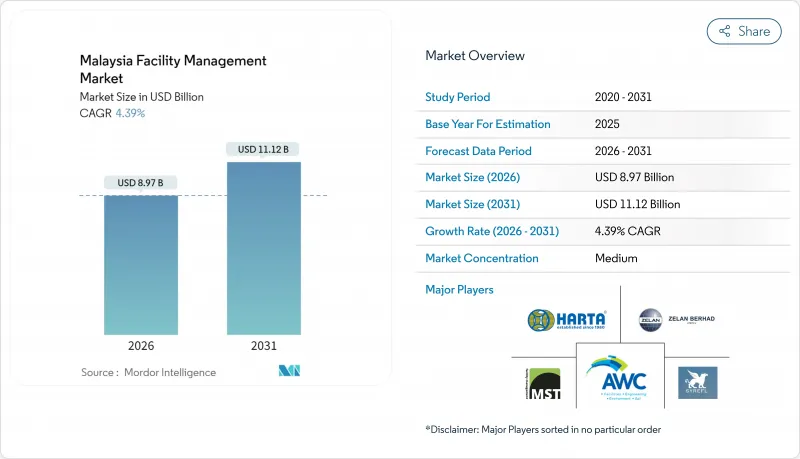
预计马来西亚设施管理市场将从 2025 年的 85.9 亿美元成长到 2026 年的 89.7 亿美元,到 2031 年将达到 111.2 亿美元,2026 年至 2031 年的复合年增长率为 4.39%。
强劲的成长前景表明,服务供应商正在迅速适应新的安全法规、智慧建筑要求和不断扩大的基础设施计划。以100亿马币(23.6亿美元)机场现代化计画为首的强有力的公私合营(PPP)支出,正促使整合供应商签订长期合约。数位双胞胎平台、人工智慧调度和物联网感测器正在变革日常维护作业,提高运作和能源利用率。更严格的ESG报告规则和国家能源转型蓝图促使客户在设施竞标中要求可衡量的永续性成果。同时,汇率波动和劳动力短缺正促使企业实现重复性任务的自动化,并预先协商进口设备合约。
马来西亚设施管理市场趋势与洞察
监理改革重塑合规规则
将于2024年6月1日生效的《2022年职业安全与健康修正法案》将扩大适用范围至所有职场,并将违规罚款提高十倍至马币(约合117.77万日元)。医院、私立学校和共享办公空间正在聘请专业的设施管理人员,进行风险审核,培训职业安全与健康协调员,并维护数位化合规记录。医疗机构正在承担不断上涨的营运成本,马来亚大学医学中心甚至将部分专家的费用提高了200%以上,以弥补安全方面的投资。吉隆坡的需求最为迫切,因为那里的高层建筑和多租户建筑使得疏散计画更加复杂。拥有认证安全工程师和即时事故仪表板的服务供应商正获得多年期合同,合约中包含针对不合规行为的绩效处罚条款。
透过技术整合提高营运效率
Digital Nacional 的人工智慧驱动型网路管理系统实现了 99.8% 的运转率,并将警报数量减少了 500%,为预测性维护树立了明确的标竿。物联网电錶将资料传输至能源仪表板,可在几分钟内而非几天内侦测到异常能耗模式。实施数位双胞胎使维护成本降低了 30%,计划外设备故障减少了 70%。吉隆坡一栋办公大楼在实施物联网能源管理系统后,舒适度提升,运作运作时间也得以缩短。一家豪华饭店透过人工智慧优化冷冻系统,实现了 9% 的节能效果,并加快了合规性报告速度。 UEM Edgenta 的 SmartConnect 等整合平台支援远端资产组合监控和标准化 KPI 记分卡。
劳动市场趋势对服务提供构成挑战
马来西亚各地的公司报告称,餐饮服务业面临25%的员工缺口,迫使他们缩短营业时间,导致收入下降15%。支撑硬性服务业的建设业仍严重依赖外籍劳工,人工林的外籍劳工比例超过70%。儘管政府已取消行业配额以加快招聘,但签证批准瓶颈依然存在,尤其是技术工人的签证。薪资通膨加速,包括一家大规模政府关联投资公司(GLIC)采用3,100马币(约730.18美元)的最低生活工资标准,对清洁、保全和维修等行业的工资结构产生了影响。虽然企业目前正在引入自动清洁机器人和集中式服务台来控制不断上涨的人事费用,但劳动力短缺仍然是短期内最大的营运风险。
细分市场分析
到2025年,硬性服务将占马来西亚设施管理市场份额的62.08%,这主要得益于消防安全、机电(机械、电气和管道)以及资产健康检查等方面的合规支出增加。光是柔佛州新山的资料中心扩建就将新增1.6吉瓦的关键容量,需要对机械和电气设备进行全天候维护。软性服务虽然规模较小,但预计到2031年将以4.42%的复合年增长率成长,因为混合职场体验正成为竞争优势。非接触式清洁机器人、按需餐饮平台和预测性人员配置引擎在高端租户中越来越受欢迎。服务提供者正在利用访客分析和行动服务台来提高租户满意度,并将服务从成本中心转变为收益保障机制。
其他福利:
- Excel格式的市场预测(ME)表
- 分析师支持(3个月)
目录
第一章 引言
- 研究假设和市场定义
- 调查范围
第二章调查方法
第三章执行摘要
第四章 市场情势
- 市场概览
- 目前运转率
- 主要FM业者的盈利能力
- 劳动指标 - 劳动参与率
- 按服务类型分類的设施管理市场占有率(%)
- 以硬性服务分類的设施管理市场占有率(%)
- 以软性服务分類的设施管理市场占有率(%)
- 主要都会区的都市化和人口成长
- 马来西亚基础建设发展计画:产业投资重点
- 与劳动和安全标准相关的监管驱动因素
- 市场驱动因素
- 监理改革重塑合规要求
- 技术整合提升营运效率
- ESG合规性成为竞争优势。
- 绩效合约是建立长期伙伴关係的基础。
- 智慧建筑规范推动对设施管理数位双胞胎的需求
- 公私合营计划加速设施管理外包
- 市场限制
- 劳动力市场动态为服务提供带来挑战。
- 利率上升限制了资本预算
- 供应商格局分散,限制了标准化。
- 汇率波动会增加进口FM技术的成本。
- 价值链分析
- PESTEL 分析
- 新参与企业的监管和法律体制
- 宏观经济指标对FM需求的影响
- 波特五力分析
- 供应商的议价能力
- 买方的议价能力
- 新进入者的威胁
- 替代品的威胁
- 竞争对手之间的竞争
- 投资与资金筹措分析
第五章 市场规模与成长预测
- 按服务类型
- 硬服务
- 资产管理
- 机电及暖通空调服务
- 消防设备和安全措施
- 其他硬体维修服务
- 软服务
- 办公室支援与安全
- 清洁服务
- 餐饮服务
- 其他软性调频服务
- 硬服务
- 按规定表格
- 内部管理
- 外包
- 单频调频
- 综合设施管理
- 综合设施管理(综合FM)
- 按最终用户行业划分
- 商业设施(IT/通讯、零售/仓储等)
- 餐饮服务业(饭店、餐厅、大型餐厅)
- 公共及公共基础设施(政府、教育、交通)
- 医疗保健(公立和私立机构)
- 工业和流程(製造业、能源业、采矿业)
- 其他终端用户产业(多用户住宅、娱乐、运动和休閒)
第六章 竞争情势
- 市场集中度
- 策略发展与伙伴关係
- 市占率分析
- 公司简介
- AWC Berhad
- MST Facilities Sdn Bhd.
- Harta Maintenance Sdn Bhd
- Zelan AM Services Sdn Bhd
- SDE Facilities Management Sdn Bhd
- SYREFL Holdings Sdn Bhd
- UDA Dayaurus Sdn. Bhd.
- Sepadu Group
- TH Properties Sdn Bhd
- Savills Malaysia
- SPS Facilities
- ISS Facility Services
- GFM Services Berhad
- CBRE
- Cushman & Wakefield Inc.
第七章 市场机会与未来展望
The Malaysia facility management market is expected to grow from USD 8.59 billion in 2025 to USD 8.97 billion in 2026 and is forecast to reach USD 11.12 billion by 2031 at 4.39% CAGR over 2026-2031.
The solid growth outlook shows how quickly service providers are adapting to new safety rules, smart-building mandates, and expanding infrastructure projects. Strong public-private partnership spending, led by an airport modernization program worth RM10 billion (USD 2.36 billion), is pulling integrated suppliers into long-term contracts. Digital twin platforms, artificial intelligence scheduling, and IoT sensors are reshaping day-to-day maintenance tasks while improving uptime and energy use. Stricter ESG reporting rules and the National Energy Transition Roadmap are prompting clients to demand measurable sustainability results in their facility tenders. At the same time, currency swings and labor shortages are prompting companies to automate repetitive work and renegotiate imported equipment contracts in advance.
Malaysia Facility Management Market Trends and Insights
Regulatory overhaul reshapes compliance rules
The Occupational Safety and Health Amendment Act 2022, effective 1 June 2024, broadens coverage to every workplace and raises violation fines tenfold to RM500,000 (USD 117,771.76). Hospitals, private schools, and co-working sites now hire specialist facility managers to conduct risk audits, train OSH coordinators, and keep digital compliance logs. Healthcare operators are absorbing higher operating costs, with Universiti Malaya Medical Centre raising some specialist fees by over 200% to offset safety investments. Demand is strongest in Kuala Lumpur, where high-rise density and multi-tenant structures complicate evacuation plans. Service providers with certified safety engineers and real-time incident dashboards are winning multi-year contracts that embed performance penalties for non-compliance.
Technology integration lifts operational efficiency
Digital Nasional Berhad's AI-driven network management delivered 99.8% uptime and cut alarm counts by 500%, offering a clear benchmark for predictive building maintenance. IoT meters feed energy dashboards that spot abnormal consumption patterns within minutes rather than days. Digital twin rollouts trim maintenance expenses by 30% and slash unscheduled equipment failures by 70%. A Kuala Lumpur office block recorded comfort improvements and lower HVAC runtime after deploying an IoT energy management system. AI chiller optimization at a luxury hotel yielded 9% energy savings plus faster compliance reporting. Integrated platforms, such as UEM Edgenta's SmartConnect, enable remote portfolio oversight and standardized KPI scorecards.
Labor market dynamics challenge service delivery
Businesses across Malaysia report 25% understaffing in food-service operations, forcing shorter opening hours and lowering revenue by 15%. The construction trades that underpin hard-service capacity still rely on foreign workers, with plantations running at more than 70% overseas labor share. The government has waived industry quotas to speed recruitment, yet visa processing bottlenecks persist, especially for skilled technicians. Wage inflation is accelerating; large Government-Linked Investment Companies set a RM3,100 (USD 730.18) living-wage floor, cascading into cleaning, security, and maintenance pay scales. Providers now deploy autonomous cleaning robots and centralized help-desks to mitigate rising payroll costs, yet talent scarcity remains the top short-term operational risk.
Other drivers and restraints analyzed in the detailed report include:
- ESG compliance gains strategic weight
- Outcome-based contracts deepen partnerships
- Currency volatility lifts imported tech costs
For complete list of drivers and restraints, kindly check the Table Of Contents.
Segment Analysis
Hard Services generated 62.08% of the Malaysia facility management market share in 2025, supported by rising compliance spending on fire safety, MEP, and asset integrity inspections. Data-center expansion in Johor Bahru alone adds 1.6 GW of critical capacity that requires round-the-clock mechanical and electrical coverage. Soft Services, although smaller in value, will grow at a 4.42% CAGR to 2031 as workplace experience becomes a competitive tool in hybrid offices. Contactless cleaning robots, on-demand catering platforms, and predictive staffing engines are gaining traction among blue-chip tenants. Providers leverage visitor analytics and mobile help-desks to raise occupant satisfaction scores, backing the shift from cost-center to revenue-protection logic.
The Malaysia Facility Management Market Report is Segmented by Service Type (Hard Services, Soft Services), Offering Type (In-House, Outsourced), End-User Industry (Commercial, Hospitality, Institutional and Public Infrastructure, Healthcare, Industrial and Process, Other End-User Industries). The Market Forecasts are Provided in Terms of Value (USD).
List of Companies Covered in this Report:
- AWC Berhad
- MST Facilities Sdn Bhd.
- Harta Maintenance Sdn Bhd
- Zelan AM Services Sdn Bhd
- SDE Facilities Management Sdn Bhd
- SYREFL Holdings Sdn Bhd
- UDA Dayaurus Sdn. Bhd.
- Sepadu Group
- TH Properties Sdn Bhd
- Savills Malaysia
- SPS Facilities
- ISS Facility Services
- GFM Services Berhad
- CBRE
- Cushman & Wakefield Inc.
Additional Benefits:
- The market estimate (ME) sheet in Excel format
- 3 months of analyst support
TABLE OF CONTENTS
1 INTRODUCTION
- 1.1 Study Assumptions and Market Definition
- 1.2 Scope of the Study
2 RESEARCH METHODOLOGY
3 EXECUTIVE SUMMARY
4 MARKET LANDSCAPE
- 4.1 Market Overview
- 4.1.1 Current Occupancy Rates
- 4.1.2 Profitability Rates of Major FM Players
- 4.1.3 Workforce Indicators - Labor Participation
- 4.1.4 Facility Management Market Share (%), by Service Type
- 4.1.5 Facility Management Market Share (%), by Hard Services
- 4.1.6 Facility Management Market Share (%), by Soft Services
- 4.1.7 Urbanization and Population Growth in Major Metros
- 4.1.8 Sector Investment Priorities in Malaysia's Infrastructure Pipeline
- 4.1.9 Regulatory Drivers Specific to Labour and Safety Standards
- 4.2 Market Drivers
- 4.2.1 Regulatory Overhaul Reshapes Compliance Requirements
- 4.2.2 Technology Integration Drives Operational Efficiency
- 4.2.3 ESG Compliance Becomes Competitive Differentiator
- 4.2.4 Outcome-Based Contracting Anchors Long-Term Partnerships
- 4.2.5 Smart Building Mandates Propel Demand for FM Digital Twins
- 4.2.6 Public-Private Partnership Projects Accelerate FM Outsourcing
- 4.3 Market Restraints
- 4.3.1 Labor Market Dynamics Challenge Service Delivery
- 4.3.2 Rising Interest Rates Constrain Capital Budgets
- 4.3.3 Fragmented Vendor Landscape Limits Standardization
- 4.3.4 Currency Volatility Increases Cost of Imported FM Technologies
- 4.4 Value Chain Analysis
- 4.5 PESTEL Analysis
- 4.6 Regulatory and Legislative Framework for Market Entrants
- 4.7 Impact of Macroeconomic Indicators on FM Demand
- 4.8 Porter's Five Forces Analysis
- 4.8.1 Bargaining Power of Suppliers
- 4.8.2 Bargaining Power of Buyers
- 4.8.3 Threat of New Entrants
- 4.8.4 Threat of Substitute Services
- 4.8.5 Intensity of Competitive Rivalry
- 4.9 Investment and Funding Analysis
5 MARKET SIZE AND GROWTH FORECASTS (VALUE)
- 5.1 By Service Type
- 5.1.1 Hard Services
- 5.1.1.1 Asset Management
- 5.1.1.2 MEP and HVAC Services
- 5.1.1.3 Fire Systems and Safety
- 5.1.1.4 Other Hard FM Services
- 5.1.2 Soft Services
- 5.1.2.1 Office Support and Security
- 5.1.2.2 Cleaning Services
- 5.1.2.3 Catering Services
- 5.1.2.4 Other Soft FM Services
- 5.1.1 Hard Services
- 5.2 By Offering Type
- 5.2.1 In-house
- 5.2.2 Outsourced
- 5.2.2.1 Single FM
- 5.2.2.2 Bundled FM
- 5.2.2.3 Integrated FM
- 5.3 By End-user Industry
- 5.3.1 Commercial (IT and Telecom, Retail and Warehouses, etc.)
- 5.3.2 Hospitality (Hotels, Eateries, Large-scale Restaurants)
- 5.3.3 Institutional and Public Infrastructure (Govt, Education, Transportation)
- 5.3.4 Healthcare (Public and Private Facilities)
- 5.3.5 Industrial and Process (Manufacturing, Energy, Mining)
- 5.3.6 Other End-user Industries (Multi-housing, Entertainment, Sports and Leisure)
6 COMPETITIVE LANDSCAPE
- 6.1 Market Concentration
- 6.2 Strategic Moves and Partnerships
- 6.3 Market Share Analysis
- 6.4 Company Profiles (includes Global level Overview, Market level overview, Core Segments, Financials as available, Strategic Information, Market Rank/Share for key companies, Products and Services, and Recent Developments)
- 6.4.1 AWC Berhad
- 6.4.2 MST Facilities Sdn Bhd.
- 6.4.3 Harta Maintenance Sdn Bhd
- 6.4.4 Zelan AM Services Sdn Bhd
- 6.4.5 SDE Facilities Management Sdn Bhd
- 6.4.6 SYREFL Holdings Sdn Bhd
- 6.4.7 UDA Dayaurus Sdn. Bhd.
- 6.4.8 Sepadu Group
- 6.4.9 TH Properties Sdn Bhd
- 6.4.10 Savills Malaysia
- 6.4.11 SPS Facilities
- 6.4.12 ISS Facility Services
- 6.4.13 GFM Services Berhad
- 6.4.14 CBRE
- 6.4.15 Cushman & Wakefield Inc.
7 MARKET OPPORTUNITIES AND FUTURE OUTLOOK
- 7.1 White-space and Unmet-Need Assessment
- 7.2 Technology-led Integrated FM (IoT, BMS, AI-based Predictive Maintenance)
- 7.3 ESG-compliant FM Solutions Demand
- 7.4 Future Service-Model Shifts (Outcome-based Contracts)

 烟草综合设施管理市场:按服务类型、设施类型、合约类型、组织规模和最终用户划分 - 2026-2032 年全球预测综合设施管理市场:按服务类型、部署模式和最终用户划分 - 2026-2032年全球预测
 2026年设施管理领域十大成长机会亚太地区设施管理市场,2026-2031年
 机器人即服务 (RaaS) 市场分析及至 2035 年预测:按类型、产品类型、服务、技术、组件、应用、部署类型、最终用户和功能划分电脑辅助设施管理 (CAFM) 市场分析及至 2035 年预测:按类型、产品类型、服务、技术、组件、应用、部署类型、最终用户和模组划分设施管理市场分析及预测(至2035年):依类型、产品类型、服务、技术、组件、应用、部署类型、最终用户、功能及解决方案划分
 亚太地区设施管理:市场占有率分析、产业趋势与统计、成长预测(2026-2031)新加坡设施管理:市场占有率分析、产业趋势与统计、成长预测(2026-2031)欧洲设施管理:市场占有率分析、产业趋势与统计、成长预测(2026-2031)