


 |
市场调查报告书
商品编码
1885846
医药级蛋白水解物市场机会、成长驱动因素、产业趋势分析及预测(2025-2034年)Pharmaceutical-Grade Protein Hydrolysates Market Opportunity, Growth Drivers, Industry Trend Analysis, and Forecast 2025 - 2034 |
||||||

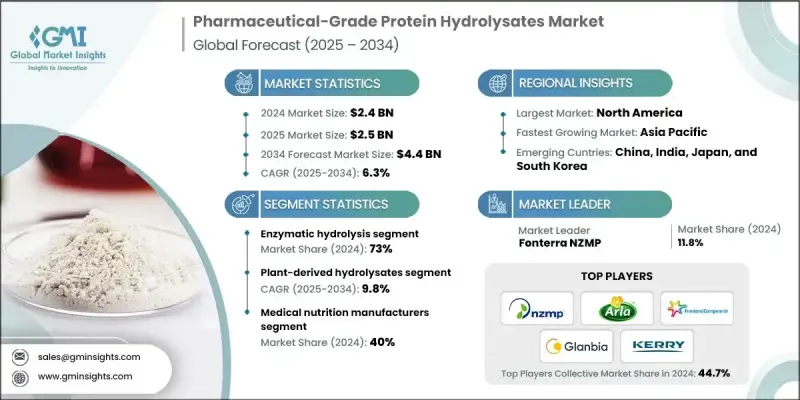
2024 年全球药用级蛋白质水解物市场价值为 24 亿美元,预计到 2034 年将以 6.3% 的复合年增长率增长至 44 亿美元。
市场扩张的驱动力在于消费者对针对特定健康需求的营养和治疗产品的需求不断增长。蛋白质水解物是指透过酵素或酸基製程将蛋白质分解成较小的胜肽或胺基酸,从而提高其消化率和生物利用度。在製药领域,这些水解物对于医疗营养、功能性食品和膳食补充剂至关重要,可用于解决营养不良、胃肠道疾病和免疫缺陷等问题。其高纯度、安全性和有效性使其适用于婴幼儿、老年患者和体弱者等弱势族群。此外,它们还有助于肌肉发育、伤口癒合和免疫功能,进一步凸显了其治疗价值。医疗营养、药物传递系统和运动营养领域对蛋白质水解物的日益广泛应用,正推动市场需求的持续成长。
| 市场范围 | |
|---|---|
| 起始年份 | 2024 |
| 预测年份 | 2025-2034 |
| 起始值 | 24亿美元 |
| 预测值 | 44亿美元 |
| 复合年增长率 | 6.3% |
至2034年,植物蛋白水解物市场将以9.8%的复合年增长率成长。对永续发展的关注、消费者对清洁标籤产品的偏好,以及避免乳糖相关问题的需求,正在推动对大豆蛋白和豌豆蛋白等植物蛋白的需求。酵素水解可以改善植物蛋白的功能特性,例如提高其在酸性pH值下的溶解度,使其能够应用于强化饮料和临床营养配方中。
酵素水解法凭藉其精准性、安全性以及能够以极少的副产物生产高纯度产品的优势,在製药工艺领域占据主导地位,预计到2024年将占据73%的市场份额。製药公司青睐该方法,是因为它符合严格的监管标准,并且适用于敏感患者群体。
2024年,北美药用级蛋白水解物市场占据36.9%的市占率。该地区的成长主要受人口老化、慢性病盛行率上升以及个人化医疗日益普及的推动。对医用营养品和临床食品的高需求,加上严格的品质法规和先进的加工技术,促进了高品质水解物的生产。强大的医药和营养保健品产业,以及巨额的医疗保健支出,进一步支撑了市场的发展。
全球药用级蛋白水解物市场的主要参与者包括雅培实验室、AMCO Proteins、Arla Foods Ingredients Group、Fonterra NZMP、FrieslandCampina Ingredients、Glanbia plc、Hilmar Cheese Company, Inc.、Hofseth BioCare ASA、Ingredia SA、Kerry Group plc 和宁波英诺医化有限公司。各公司致力于透过水解技术创新、提高生物利用度以及提供植物蛋白产品来拓展产品组合,以满足不断增长的消费者和治疗需求。与製药、营养保健品和临床营养公司进行策略合作有助于扩大市场覆盖率并开发应用。研发投入推动了婴幼儿和老年人等敏感族群的高级水解物的开发。向新兴市场进行地理扩张以及建立在地化生产设施,确保了合规性和更快的分销速度。
目录
第一章:方法论与范围
第二章:执行概要
第三章:行业洞察
- 产业生态系分析
- 供应商格局
- 利润率
- 每个阶段的价值增加
- 影响价值链的因素
- 中断
- 产业影响因素
- 成长驱动因素
- 产业陷阱与挑战
- 市场机会
- 成长潜力分析
- 监管环境
- 北美洲
- 欧洲
- 亚太地区
- 拉丁美洲
- 中东和非洲
- 波特的分析
- PESTEL 分析
- 价格趋势
- 按地区
- 按蛋白质来源
- 未来市场趋势
- 技术与创新格局
- 当前技术趋势
- 新兴技术
- 专利格局
- 贸易统计(HS编码)(註:仅提供重点国家的贸易统计资料)
- 主要进口国
- 主要出口国
- 永续性和环境方面
- 永续实践
- 减少废弃物策略
- 生产中的能源效率
- 环保倡议
- 碳足迹考量
第四章:竞争格局
- 介绍
- 公司市占率分析
- 按地区
- 北美洲
- 欧洲
- 亚太地区
- 拉丁美洲
- MEA
- 按地区
- 公司矩阵分析
- 主要市场参与者的竞争分析
- 竞争定位矩阵
- 关键进展
- 併购
- 合作伙伴关係与合作
- 新产品发布
- 扩张计划
第五章:市场估算与预测:依蛋白质来源划分,2021-2034年
- 主要趋势
- 乳源蛋白水解物
- 乳清蛋白水解物
- 酪蛋白水解物
- 植物源蛋白水解物
- 大豆蛋白水解物
- 豌豆蛋白水解物
- 其他的
- 动物源性蛋白质水解物
- 蛋清蛋白水解物
- 胶原蛋白/明胶水解物
- 鱼/海洋蛋白质水解物
- 其他来源水解物
第六章:市场估算与预测:依製造流程划分,2021-2034年
- 主要趋势
- 酵素水解
- 化学水解
- 微生物发酵
- 混合/顺序过程
第七章:市场估计与预测:依应用领域划分,2021-2034年
- 关键趋势
- 临床/肠内营养
- 聚合物配方
- 寡聚体/胜肽基製剂
- 管饲应用
- 口服营养补充品
- 重症监护及ICU营养
- 特殊医学食品/医用食品
- 苯酮尿症和代谢紊乱製剂
- 肾臟疾病製剂
- 肝病製剂
- 囊性纤维化营养
- 治疗/药物应用
- ACE抑制胜肽
- 抗氧化生物活性胜肽
- 免疫调节应用
- 伤口癒合配方
- 药物输送系统
- 婴儿配方奶粉
- 部分水解配方(水解度 10-30%)
- 深度水解配方(DH30-60%)
- 胺基酸配方(DH >80%)
- 低过敏配方
- 肠外营养
- 胺基酸溶液
- 二肽製剂(丙氨酰谷氨酰胺)
- 全肠外营养(TPN)
- 週边肠外营养(PPN)
- 运动营养
- 快速吸收配方
- 肌肉恢復应用
- 性能增强产品
第八章:市场估算与预测:依最终用途产业划分,2021-2034年
- 主要趋势
- 医用营养品生产商
- 製药公司
- 婴儿配方奶粉製造商
- 营养保健品公司
第九章:市场估计与预测:依地区划分,2021-2034年
- 主要趋势
- 北美洲
- 我们
- 加拿大
- 欧洲
- 德国
- 英国
- 法国
- 西班牙
- 义大利
- 欧洲其他地区
- 亚太地区
- 中国
- 印度
- 日本
- 澳洲
- 韩国
- 亚太其他地区
- 拉丁美洲
- 巴西
- 墨西哥
- 阿根廷
- 拉丁美洲其他地区
- 中东和非洲
- 沙乌地阿拉伯
- 南非
- 阿联酋
- 中东和非洲其他地区
第十章:公司简介
- Abbott Laboratories
- AMCO Proteins
- Arla Foods Ingredients Group
- Fonterra NZMP
- FrieslandCampina Ingredients
- Glanbia plc
- Hilmar Cheese Company, Inc.
- Hofseth BioCare ASA
- Ingredia SA
- Kerry Group plc
- NINGBO INNO PHARMCHEM CO., LTD
The Global Pharmaceutical-Grade Protein Hydrolysates Market was valued at USD 2.4 billion in 2024 and is estimated to grow at a CAGR of 6.3% to reach USD 4.4 billion by 2034.
The market's expansion is fueled by rising demand for specialized nutritional and therapeutic products that target specific health needs. Protein hydrolysates are proteins broken down into smaller peptides or amino acids through enzymatic or acid-based processes, improving digestibility and bioavailability. In the pharmaceutical sector, these hydrolysates are critical for medical nutrition, functional foods, and dietary supplements that address malnutrition, gastrointestinal disorders, and immune deficiencies. Their high purity, safety, and efficacy make them suitable for vulnerable populations such as infants, elderly patients, and those with compromised health. Furthermore, they support muscle development, wound recovery, and immune function, reinforcing their therapeutic importance. Increasing adoption in medical nutrition, drug delivery systems, and sports nutrition is driving steady demand.
| Market Scope | |
|---|---|
| Start Year | 2024 |
| Forecast Year | 2025-2034 |
| Start Value | $2.4 Billion |
| Forecast Value | $4.4 Billion |
| CAGR | 6.3% |
The plant-derived protein hydrolysates segment will grow at a CAGR of 9.8% through 2034. Sustainability concerns and clean-label preferences, along with the need to avoid lactose-related issues, are pushing demand for plant-based sources such as soy and pea proteins. Enzymatic hydrolysis improves the functional properties of plant proteins, including solubility at acidic pH, enabling their use in fortified beverages and clinical nutrition formulations.
The enzymatic hydrolysis dominates the manufacturing processes segment, holding a 73% share in 2024, owing to its precision, safety, and ability to produce high-purity products with minimal by-products. Pharmaceutical manufacturers favor this method for its compliance with stringent regulatory standards and suitability for sensitive patient populations.
North America Pharmaceutical-Grade Protein Hydrolysates Market accounted for a 36.9% share in 2024. Growth in the region is driven by an aging population, rising chronic disease prevalence, and increasing adoption of personalized medicine. High demand for medical nutrition and clinical foods, combined with stringent quality regulations and advanced processing technologies, supports the production of high-quality hydrolysates. A strong pharmaceutical and nutraceutical sector, coupled with substantial healthcare expenditure, further underpins the market's development.
Major players in the Global Pharmaceutical-Grade Protein Hydrolysates Market include Abbott Laboratories, AMCO Proteins, Arla Foods Ingredients Group, Fonterra NZMP, FrieslandCampina Ingredients, Glanbia plc, Hilmar Cheese Company, Inc., Hofseth BioCare ASA, Ingredia SA, Kerry Group plc, and NINGBO INNO PHARMCHEM CO., LTD. Companies are focusing on expanding their product portfolios through innovation in hydrolysis techniques, enhanced bioavailability, and plant-based protein offerings to meet growing consumer and therapeutic demands. Strategic collaborations with pharmaceutical, nutraceutical, and clinical nutrition companies help improve market reach and application development. Investments in R&D enable the development of premium-grade hydrolysates tailored for sensitive populations, including infants and the elderly. Geographic expansion into emerging markets and localized production facilities ensures regulatory compliance and faster distribution.
Table of Contents
Chapter 1 Methodology & Scope
- 1.1 Market scope and definition
- 1.2 Research design
- 1.2.1 Research approach
- 1.2.2 Data collection methods
- 1.3 Data mining sources
- 1.3.1 Global
- 1.3.2 Regional/Country
- 1.4 Base estimates and calculations
- 1.4.1 Base year calculation
- 1.4.2 Key trends for market estimation
- 1.5 Primary research and validation
- 1.5.1 Primary sources
- 1.6 Forecast model
- 1.7 Research assumptions and limitations
Chapter 2 Executive Summary
- 2.1 Industry 360° synopsis
- 2.2 Key market trends
- 2.2.1 Regional
- 2.2.2 Protein sources
- 2.2.3 Manufacturing process
- 2.2.4 Application
- 2.2.5 End Use industry
- 2.3 TAM Analysis, 2025-2034
- 2.4 CXO perspectives: Strategic imperatives
- 2.4.1 Executive decision points
- 2.4.2 Critical success factors
- 2.5 Future Outlook and Strategic Recommendations
Chapter 3 Industry Insights
- 3.1 Industry ecosystem analysis
- 3.1.1 Supplier landscape
- 3.1.2 Profit margin
- 3.1.3 Value addition at each stage
- 3.1.4 Factor affecting the value chain
- 3.1.5 Disruptions
- 3.2 Industry impact forces
- 3.2.1 Growth drivers
- 3.2.2 Industry pitfalls and challenges
- 3.2.3 Market opportunities
- 3.3 Growth potential analysis
- 3.4 Regulatory landscape
- 3.4.1 North America
- 3.4.2 Europe
- 3.4.3 Asia Pacific
- 3.4.4 Latin America
- 3.4.5 Middle East & Africa
- 3.5 Porter's analysis
- 3.6 PESTEL analysis
- 3.7 Price trends
- 3.7.1 By region
- 3.7.2 By protein source
- 3.8 Future market trends
- 3.9 Technology and Innovation landscape
- 3.9.1 Current technological trends
- 3.9.2 Emerging technologies
- 3.10 Patent Landscape
- 3.11 Trade statistics (HS code) ( Note: the trade statistics will be provided for key countries only)
- 3.11.1 Major importing countries
- 3.11.2 Major exporting countries
- 3.12 Sustainability and environmental aspects
- 3.12.1 Sustainable practices
- 3.12.2 Waste reduction strategies
- 3.12.3 Energy efficiency in production
- 3.12.4 Eco-friendly initiatives
- 3.13 Carbon footprint consideration
Chapter 4 Competitive Landscape, 2024
- 4.1 Introduction
- 4.2 Company market share analysis
- 4.2.1 By region
- 4.2.1.1 North America
- 4.2.1.2 Europe
- 4.2.1.3 Asia Pacific
- 4.2.1.4 LATAM
- 4.2.1.5 MEA
- 4.2.1 By region
- 4.3 Company matrix analysis
- 4.4 Competitive analysis of major market players
- 4.5 Competitive positioning matrix
- 4.6 Key developments
- 4.6.1 Mergers & acquisitions
- 4.6.2 Partnerships & collaborations
- 4.6.3 New Product Launches
- 4.6.4 Expansion Plans
Chapter 5 Market Estimates and Forecast, By Protein Source, 2021-2034 (USD Million & Kilo Tons)
- 5.1 Key trends
- 5.2 Milk-derived protein hydrolysates
- 5.2.1 Whey protein hydrolysates
- 5.2.2 Casein hydrolysates
- 5.3 Plant-derived protein hydrolysates
- 5.3.1 Soy protein hydrolysates
- 5.3.2 Pea protein hydrolysates
- 5.3.3 Others
- 5.4 Animal-derived protein hydrolysates
- 5.4.1 Egg protein hydrolysates
- 5.4.2 Collagen/gelatin hydrolysates
- 5.5 Fish/marine protein hydrolysates
- 5.6 Other sources hydrolysates
Chapter 6 Market Estimates and Forecast, By Manufacturing Process, 2021-2034 (USD Million & Kilo Tons)
- 6.1 Key trends
- 6.2 Enzymatic hydrolysis
- 6.3 Chemical hydrolysis
- 6.4 Microbial fermentation
- 6.5 Hybrid/sequential processes
Chapter 7 Market Estimates and Forecast, By Application, 2021-2034 (USD Million & Kilo Tons)
- 7.1 Key trend
- 7.2 Clinical/enteral nutrition
- 7.2.1 Polymeric formulations
- 7.2.2 Oligomeric/peptide-based formulations
- 7.2.3 Tube feeding applications
- 7.2.4 Oral nutritional supplements
- 7.2.5 Critical care & ICU nutrition
- 7.3 Medical foods/FSMP
- 7.3.1 PKU & metabolic disorder formulations
- 7.3.2 Renal disease formulations
- 7.3.3 Hepatic disease formulations
- 7.3.4 Cystic fibrosis nutrition
- 7.4 Therapeutic/pharmaceutical applications
- 7.4.1 Ace inhibition peptides
- 7.4.2 Antioxidant bioactive peptides
- 7.4.3 Immunomodulatory applications
- 7.4.4 Wound healing formulations
- 7.4.5 Drug delivery systems
- 7.5 Infant formula
- 7.5.1 Partially hydrolyzed formulas (DH 10-30%)
- 7.5.2 Extensively hydrolyzed formulas (DH30-60%)
- 7.5.3 Amino acid-based formulas (DH >80%)
- 7.5.4 Hypoallergenic formulations
- 7.6 Parenteral nutrition
- 7.6.1 Amino acid solutions
- 7.6.2 Dipeptide formulations (alanyl-glutamine)
- 7.6.3 Total parenteral nutrition (TPN)
- 7.6.4 Peripheral parenteral nutrition (PPN)
- 7.7 Sports nutrition
- 7.7.1 Rapid absorption formulations
- 7.7.2 Muscle recovery applications
- 7.7.3 Performance enhancement products
Chapter 8 Market Estimates and Forecast, By End Use Industry, 2021-2034 (USD Million & Kilo Tons)
- 8.1 Key trends
- 8.2 Medical nutrition manufacturers
- 8.3 Pharmaceutical companies
- 8.4 Infant formula manufacturers
- 8.5 Nutraceutical companies
Chapter 9 Market Estimates and Forecast, By Region, 2021-2034 (USD Million & Kilo Tons)
- 9.1 Key trends
- 9.2 North America
- 9.2.1 U.S.
- 9.2.2 Canada
- 9.3 Europe
- 9.3.1 Germany
- 9.3.2 UK
- 9.3.3 France
- 9.3.4 Spain
- 9.3.5 Italy
- 9.3.6 Rest of Europe
- 9.4 Asia Pacific
- 9.4.1 China
- 9.4.2 India
- 9.4.3 Japan
- 9.4.4 Australia
- 9.4.5 South Korea
- 9.4.6 Rest of Asia Pacific
- 9.5 Latin America
- 9.5.1 Brazil
- 9.5.2 Mexico
- 9.5.3 Argentina
- 9.5.4 Rest of Latin America
- 9.6 Middle East and Africa
- 9.6.1 Saudi Arabia
- 9.6.2 South Africa
- 9.6.3 UAE
- 9.6.4 Rest of Middle East and Africa
Chapter 10 Company Profiles
- 10.1 Abbott Laboratories
- 10.2 AMCO Proteins
- 10.3 Arla Foods Ingredients Group
- 10.4 Fonterra NZMP
- 10.5 FrieslandCampina Ingredients
- 10.6 Glanbia plc
- 10.7 Hilmar Cheese Company, Inc.
- 10.8 Hofseth BioCare ASA
- 10.9 Ingredia SA
- 10.10 Kerry Group plc
- 10.11 NINGBO INNO PHARMCHEM CO., LTD

 有机蛋白水解物市场机会、成长驱动因素、产业趋势分析及预测(2025-2034年)单细胞蛋白水解物市场机会、成长驱动因素、产业趋势分析及预测(2025-2034年)精准发酵法製备蛋白水解物市场机会、成长驱动因素、产业趋势分析及预测(2025-2034年)老年营养蛋白水解物市场机会、成长驱动因素、产业趋势分析及预测(2025-2034年)下一代蛋白质水解物市场机会、成长驱动因素、产业趋势分析及预测(2025-2034)
 蛋白质水解物市场-全球产业规模、份额、趋势、机会和预测,按类型、来源、形态、製程、应用、地区和竞争格局划分,2020-2030年预测非基因改造蛋白水解物市场机会、成长驱动因素、产业趋势分析及预测(2025-2034年)食品废弃物衍生蛋白水解物市场机会、成长驱动因素、产业趋势分析及预测(2025-2034年)发酵蛋白水解物市场机会、成长驱动因素、产业趋势分析及预测(2025-2034年)喷雾干燥蛋白水解物市场机会、成长驱动因素、产业趋势分析及预测(2025-2034年)