


 |
市场调查报告书
商品编码
1906891
法国货运与物流:市场占有率分析、产业趋势、统计数据与成长预测(2026-2031)France Freight And Logistics - Market Share Analysis, Industry Trends & Statistics, Growth Forecasts (2026 - 2031) |
||||||

※ 本网页内容可能与最新版本有所差异。详细情况请与我们联繫。
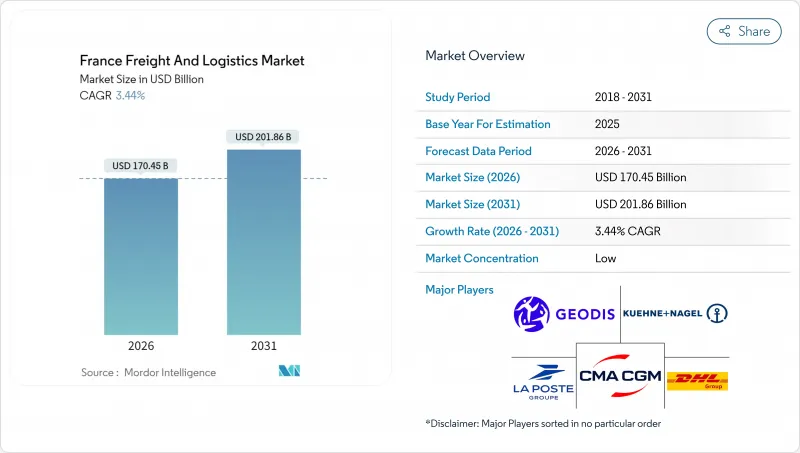
法国货运和物流市场预计将从 2025 年的 1,647.8 亿美元成长到 2026 年的 1,704.5 亿美元,到 2031 年达到 2018.6 亿美元,2026 年至 2031 年的复合年增长率为 3.44%。
基础设施的持续发展、电子商务小包裹量的快速增长以及无纸化海关程序的全面实施,都在巩固增长势头。政府20亿欧元(22亿美元)的「绿色基金」(Fonds vert)计画正在加速推进所有运输方式的脱碳计划,透过提供直接补贴和税额扣抵来降低部署新型绿色资产的成本。产业整合,特别是达飞海运集团(CMA CGM)以52亿欧元(57亿美元)收购博洛雷物流(Bollore Logistics),将催生能够提供真正端到端服务的垂直整合营运商。数位化车队远端资讯处理系统、氢气处理设施以及人工智慧驱动的风险管理引擎将提高资产利用率并减少排放,从而在「Fit-for-55」法规日益严格的背景下,助力企业保持竞争优势。
法国货运及物流市场趋势及洞察
海关程序数位化
欧盟海关法全面实施电子申报制度,使合规货物的清关时间缩短了高达30%,惠及高价值的汽车和航太产业链。利用人工智慧驱动的风险引擎进行选择性检查,使有限的边防安全官员能够专注于更复杂的检查,从而减少了卡车在加莱和勒阿弗尔的停留时间。货运代理商反映,文件工作流程更加顺畅,仲介手续费降低,有助于提升法国货运和物流市场的整体竞争力。
电子商务小包裹量快速成长
2024年,随着消费者对配送时限的要求越来越高,国内小包裹吞吐量年增超过20%。为了符合低排放区法规,像Chronopost这样的营运商开设了都市区微型配送中心,并扩大了货运自行车车队。自动化分类和人工智慧驱动的路线优化提高了配送点密度,即使网路变得更加复杂,也有助于降低小包裹成本。
司机短缺和劳动力老化
超过 3000 欧元(3310 美元)的许可证费用正在减少年轻申请人的数量,不断上涨的工资正在挤压利润率,迫使小规模企业进行外包或退出市场,从而重塑了法国货运和物流行业的竞争格局。
细分市场分析
到2025年,製造业将占法国货运和物流市场的31.21%,因为汽车、航太和製药业依赖精准的准时交货。排序和供应商管理库存(VMI)缩短了仓库停留时间,使拥有先进IT介面的供应商获得优势。批发和零售业将成为成长最快的产业,2026年至2031年的复合年增长率(CAGR)将达到3.62%,因为全通路模式推动了对靠近人口中心的微型仓配中心的需求。
国防军备重整支出将维持对机密物资储存和护航运输的需求,而粮食安全优先事项将推动农产品和食品运输量的稳定成长。能源转型政策将减少石化燃料运输,进而重塑法国货运和物流市场运输路线的获利模式。
截至2025年,货运占法国货运和物流市场的59.58%,这得益于整合的公路、铁路和海运网络,该网络能够满足重工业物流和跨境贸易的需求。物联网赋能的车辆管理平台减少了车辆閒置时间,提高了周转率,即使在柴油价格上涨的情况下也能维持利润率。小包裹递送(CEP)虽然规模较小,却是成长最快的细分市场,2026年至2031年的复合年增长率将达到3.88%,这反映了主要城市对当日送达服务的期望。库存向消费者更近的转移将推动仓储需求,而货运代理在清关和多模态协调方面仍将发挥重要作用。
客户对端到端可视性的需求正推动运输、仓储和退货服务整合到单一合约中。擅长数据分析并能製定环保优化路线的营运商正在法国竞争激烈的货运和物流市场中赢得更多市场份额。
其他福利:
- Excel格式的市场预测(ME)表
- 3个月的分析师支持
目录
第一章 引言
- 研究假设和市场定义
- 调查范围
第二章调查方法
第三章执行摘要
第四章 市场情势
- 市场概览
- 人口统计数据
- 按经济活动分類的GDP分配
- 按经济活动分類的GDP成长
- 通货膨胀
- 经济表现及概况
- 电子商务产业的趋势
- 製造业趋势
- 运输和仓储业GDP
- 出口趋势
- 进口趋势
- 燃油价格
- 卡车运输营运成本
- 卡车运输车队规模(按类型)
- 主要卡车供应商
- 物流绩效
- 透过交通方式分享
- 海运船队运力
- 班轮运输连接
- 停靠港口和演出
- 货运费率趋势
- 货物吨位趋势
- 基础设施
- 法规结构(公路和铁路)
- 法规结构(海事和航空)
- 价值炼和通路分析
- 市场驱动因素
- 海关程序数位化
- 电子商务小包裹量快速成长
- 透过绿色税收制度促进多式联运的转型
- 欧盟供应链近岸外包
- 国防重整军备物流需求
- 投资兴建氢燃料加註走廊
- 市场限制
- 驾驶人和劳动力老化
- 遵守欧盟「Fit-For-55」法规相关的资本投资成本
- 铁路网运力瓶颈(乘客优先)
- 都市区最后一公里配送区的饱和
- 市场创新
- 波特五力分析
- 新进入者的威胁
- 买方的议价能力
- 供应商的议价能力
- 替代品的威胁
- 竞争对手之间的竞争
第五章 市场规模与成长预测
- 终端用户产业
- 农业、渔业、林业
- 建设业
- 製造业
- 石油天然气、采矿和采石
- 批发和零售
- 其他的
- 物流职能
- 宅配、速递和小包裹(CEP)
- 按目的地
- 国内的
- 国际的
- 按目的地
- 货运代理
- 透过交通工具
- 航空
- 海路和内河航道
- 其他的
- 透过交通工具
- 货物运输
- 透过交通工具
- 航空
- 管道
- 铁路
- 路
- 海路和内河航道
- 透过交通工具
- 仓储
- 透过温度控制
- 非温控型
- 温度控制
- 透过温度控制
- 其他服务
- 宅配、速递和小包裹(CEP)
第六章 竞争情势
- 市场集中度
- 关键策略倡议
- 市占率分析
- 公司简介
- Balguerie Group
- CLASQUIN
- CMA CGM Group(Including CEVA Logistics)
- DACHSER
- DHL Group
- Dimotrans Group
- DSV A/S(Including DB Schenker)
- FedEx
- FM Logistic
- GEODIS
- Groupe CAT
- Kuehne+Nagel
- La Poste Group
- Rhenus Group
- Savino Del Bene SpA
- SEKO Logistics
- STEF Group
- United Parcel Service of America, Inc.(UPS)
- XPO, Inc.
- Ziegler Group
第七章 市场机会与未来展望
The France freight and logistics market is expected to grow from USD 164.78 billion in 2025 to USD 170.45 billion in 2026 and is forecast to reach USD 201.86 billion by 2031 at 3.44% CAGR over 2026-2031.
Sustained infrastructure upgrades, fast-rising e-commerce parcel flows, and full rollout of paperless customs procedures collectively reinforce the growth trajectory. The government's EUR 2 billion (USD 2.2 billion) Fonds vert program accelerates decarbonization projects across all modes, offering direct grants and tax credits that lower the cost of new green assets. Consolidation moves-most notably CMA CGM's EUR 5.2 billion (USD 5.7 billion) purchase of Bollore Logistics-create vertically integrated providers able to sell truly end-to-end services. Digital fleet telematics, hydrogen handling equipment, and AI-enabled risk engines raise asset utilization while shrinking emissions footprints, underpinning competitive advantage as Fit-for-55 obligations tighten.
France Freight And Logistics Market Trends and Insights
Digitalization of Customs Procedures
Full deployment of electronic declarations under the Union Customs Code has cut clearance times for compliant cargo by up to 30%, benefiting high-value automotive and aerospace supply chains. AI-driven risk engines enable selective inspections, freeing scarce border officers for complex checks and reducing truck dwell times at Calais and Le Havre. Freight forwarders report smoother document workflows and lower brokerage fees, enhancing the overall competitiveness of the France freight and logistics market.
Surge in E-commerce Parcel Volumes
Domestic parcel flows grew more than 20% year-on-year in 2024 as consumers demanded tighter delivery windows; operators like Chronopost opened urban micro-hubs and expanded cargo-bike fleets to comply with low-emission zones. Automated sortation and AI route optimization improve stop density, keeping cost per parcel in check even as network complexity rises.
Driver Shortage and Ageing Workforce
An estimated 60% of driving posts could remain vacant by 2026 as retirements outpace new entrants; licensing costs exceed EUR 3,000 (USD 3,310), discouraging younger applicants. Wage inflation erodes margins, forcing small fleets to subcontract or exit, reshaping the competitive fabric of the France freight and logistics industry.
Other drivers and restraints analyzed in the detailed report include:
- Green Tax Incentives for Intermodal Shift
- Near-Shoring of EU Supply Chains
- CAPEX Burden of Fit-for-55 Compliance
For complete list of drivers and restraints, kindly check the Table Of Contents.
Segment Analysis
Manufacturing held 31.21% of the France freight and logistics market share in 2025 as automotive, aerospace, and pharmaceuticals depended on high-precision just-in-time deliveries. Inbound sequencing and vendor-managed inventory keep warehouse dwell times low, favoring providers with sophisticated IT interfaces. Wholesale and retail trade rises the fastest at 3.62% CAGR (2026-2031), with omnichannel models favoring micro-fulfillment locations near dense populations.
Defense re-armament spending sustains demand for classified storage and escorted convoys, while agri-food volumes stay resilient on food-security priorities. Energy-transition policies reduce fossil-fuel traffic, reshaping lane profitability within the France freight and logistics market.
Freight transport delivered 59.58% of the France freight and logistics market size in 2025, supported by integrated road-rail-sea networks that cater to heavy industrial flows and cross-border trade. IoT-enabled fleet platforms cut empty-running and boost asset turns, preserving margins as diesel prices rise. CEP, though smaller, is the fastest-growing slice, with a 3.88% CAGR between 2026-2031, reflecting same-day delivery expectations in major cities. Inventory repositioning closer to consumers fuels warehousing demand, while freight forwarding retains relevance for customs and multimodal coordination.
Customer pressure for end-to-end visibility compels providers to bundle transport, storage, and returns services into single contracts. Players that master data analytics and eco-optimized routing gain share in the fiercely contested France freight and logistics market.
The France Freight and Logistics Market Report is Segmented by End User Industry (Agriculture, Fishing, and Forestry, Construction, Manufacturing, Oil and Gas, Mining and Quarrying, Wholesale and Retail Trade, and Others) and by Logistics Function (Courier, Express, and Parcel (CEP), Freight Forwarding, Freight Transport, Warehousing and Storage, and Other Services). The Market Forecasts are Provided in Terms of Value (USD).
List of Companies Covered in this Report:
- Balguerie Group
- CLASQUIN
- CMA CGM Group (Including CEVA Logistics)
- DACHSER
- DHL Group
- Dimotrans Group
- DSV A/S (Including DB Schenker)
- FedEx
- FM Logistic
- GEODIS
- Groupe CAT
- Kuehne+Nagel
- La Poste Group
- Rhenus Group
- Savino Del Bene SpA
- SEKO Logistics
- STEF Group
- United Parcel Service of America, Inc. (UPS)
- XPO, Inc.
- Ziegler Group
Additional Benefits:
- The market estimate (ME) sheet in Excel format
- 3 months of analyst support
TABLE OF CONTENTS
1 Introduction
- 1.1 Study Assumptions and Market Definition
- 1.2 Scope of the Study
2 Research Methodology
3 Executive Summary
4 Market Landscape
- 4.1 Market Overview
- 4.2 Demographics
- 4.3 GDP Distribution by Economic Activity
- 4.4 GDP Growth by Economic Activity
- 4.5 Inflation
- 4.6 Economic Performance and Profile
- 4.6.1 Trends in E-Commerce Industry
- 4.6.2 Trends in Manufacturing Industry
- 4.7 Transport and Storage Sector GDP
- 4.8 Export Trends
- 4.9 Import Trends
- 4.10 Fuel Price
- 4.11 Trucking Operational Costs
- 4.12 Trucking Fleet Size by Type
- 4.13 Major Truck Suppliers
- 4.14 Logistics Performance
- 4.15 Modal Share
- 4.16 Maritime Fleet Load Carrying Capacity
- 4.17 Liner Shipping Connectivity
- 4.18 Port Calls and Performance
- 4.19 Freight Pricing Trends
- 4.20 Freight Tonnage Trends
- 4.21 Infrastructure
- 4.22 Regulatory Framework (Road and Rail)
- 4.23 Regulatory Framework (Sea and Air)
- 4.24 Value Chain and Distribution Channel Analysis
- 4.25 Market Drivers
- 4.25.1 Digitalization of Customs Procedures
- 4.25.2 Surge in E-Commerce Parcel Volumes
- 4.25.3 Green Tax Incentives for Intermodal Shift
- 4.25.4 Near-Shoring of EU Supply Chains
- 4.25.5 Defence Re-Armament Logistics Demand
- 4.25.6 Hydrogen Refuelling Corridor Investments
- 4.26 Market Restraints
- 4.26.1 Driver Shortage and Ageing Workforce
- 4.26.2 CAPEX Burden of EU Fit-For-55 Compliance
- 4.26.3 Rail Network Capacity Bottlenecks (Passenger Priority)
- 4.26.4 Saturated Urban Last-Mile Delivery Zones
- 4.27 Technology Innovations in the Market
- 4.28 Porter's Five Forces Analysis
- 4.28.1 Threat of New Entrants
- 4.28.2 Bargaining Power of Buyers
- 4.28.3 Bargaining Power of Suppliers
- 4.28.4 Threat of Substitutes
- 4.28.5 Competitive Rivalry
5 Market Size and Growth Forecasts (Value, USD)
- 5.1 End User Industry
- 5.1.1 Agriculture, Fishing, and Forestry
- 5.1.2 Construction
- 5.1.3 Manufacturing
- 5.1.4 Oil and Gas, Mining and Quarrying
- 5.1.5 Wholesale and Retail Trade
- 5.1.6 Others
- 5.2 Logistics Function
- 5.2.1 Courier, Express, and Parcel (CEP)
- 5.2.1.1 By Destination Type
- 5.2.1.1.1 Domestic
- 5.2.1.1.2 International
- 5.2.1.1 By Destination Type
- 5.2.2 Freight Forwarding
- 5.2.2.1 By Mode of Transport
- 5.2.2.1.1 Air
- 5.2.2.1.2 Sea and Inland Waterways
- 5.2.2.1.3 Others
- 5.2.2.1 By Mode of Transport
- 5.2.3 Freight Transport
- 5.2.3.1 By Mode of Transport
- 5.2.3.1.1 Air
- 5.2.3.1.2 Pipelines
- 5.2.3.1.3 Rail
- 5.2.3.1.4 Road
- 5.2.3.1.5 Sea and Inland Waterways
- 5.2.3.1 By Mode of Transport
- 5.2.4 Warehousing and Storage
- 5.2.4.1 By Temperature Control
- 5.2.4.1.1 Non-Temperature Controlled
- 5.2.4.1.2 Temperature Controlled
- 5.2.4.1 By Temperature Control
- 5.2.5 Other Services
- 5.2.1 Courier, Express, and Parcel (CEP)
6 Competitive Landscape
- 6.1 Market Concentration
- 6.2 Key Strategic Moves
- 6.3 Market Share Analysis
- 6.4 Company Profiles (Includes Global Level Overview, Market Level Overview, Core Segments, Financials as Available, Strategic Information, Market Rank/Share for Key Companies, Products and Services, and Recent Developments)
- 6.4.1 Balguerie Group
- 6.4.2 CLASQUIN
- 6.4.3 CMA CGM Group (Including CEVA Logistics)
- 6.4.4 DACHSER
- 6.4.5 DHL Group
- 6.4.6 Dimotrans Group
- 6.4.7 DSV A/S (Including DB Schenker)
- 6.4.8 FedEx
- 6.4.9 FM Logistic
- 6.4.10 GEODIS
- 6.4.11 Groupe CAT
- 6.4.12 Kuehne+Nagel
- 6.4.13 La Poste Group
- 6.4.14 Rhenus Group
- 6.4.15 Savino Del Bene SpA
- 6.4.16 SEKO Logistics
- 6.4.17 STEF Group
- 6.4.18 United Parcel Service of America, Inc. (UPS)
- 6.4.19 XPO, Inc.
- 6.4.20 Ziegler Group
7 Market Opportunities and Future Outlook
- 7.1 White-Space and Unmet-Need Assessment

 2026-2030年全球货运物流市场
 中东和非洲货运物流市场:市场份额分析、行业趋势、统计数据和成长预测(2026-2031 年)义大利货运与物流:市场占有率分析、产业趋势、统计数据与成长预测(2026-2031)北美货运与物流:市场占有率分析、产业趋势与统计、成长预测(2026-2031)印尼货运与物流:市场占有率分析、产业趋势、统计及成长预测(2026-2031)德国货运和物流市场:市场份额分析、行业趋势、统计数据和成长预测(2026-2031 年)日本货运物流市场:市场占有率分析、产业趋势与统计、成长预测(2026-2031年)欧洲货运与物流:市场份额分析、行业趋势、统计数据和成长预测(2026-2031 年)马来西亚货运与物流:市场占有率分析、产业趋势、统计数据与成长预测(2026-2031)
 日本货运物流市场规模、份额、趋势及预测(按类型、最终用户及地区划分),2026-2034年